Mars Reconnaissance Orbiter (MRO)
A Cornerstone of Modern Mars Exploration
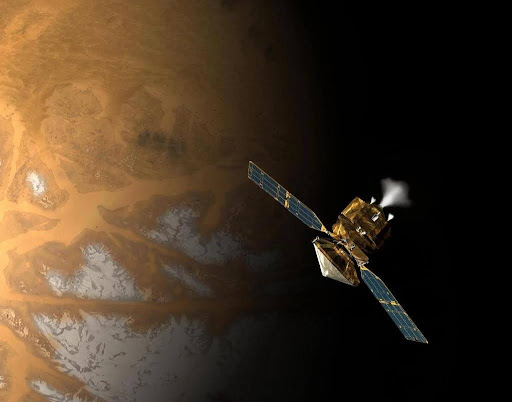
Since arriving at Mars in 2006, NASA’s Mars Reconnaissance Orbiter (MRO) has transformed our understanding of the Martian surface, atmosphere, and subsurface, while also serving as a critical communications relay for landed missions across the surface of the planet. Originally planned as a two-year mission, MRO completed its primary science phase in 2008, and has continued operations through multiple extended phases. It began its seventh extended mission in October 2025. The spacecraft was built by Lockheed Martin and is operated in partnership with NASA’s Jet Propulsion Laboratory (JPL).
Mission Timeline
- Launch: August 12, 2005
- Mars Orbit Insertion: March 2006
- Aerobraking Phase: March–November 2006
- Primary Science Phase: November 2006 – 2008
- Extended Mission Phases: 2008 – Present
- Current Phase: Seventh Extended Mission (began October 2025)
Scientific Payload
MRO carries a powerful suite of instruments designed to investigate Mars from the surface to the shallow subsurface:
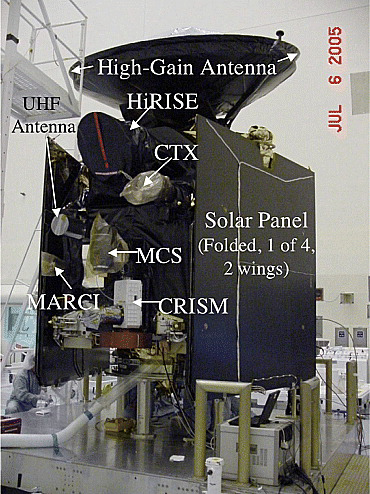
- High-Resolution Imaging Science Experiment (HiRISE) – Ultra-high-resolution imaging of surface features
- Context Camera (CTX) – Regional-scale imaging for geologic context
- Compact Reconnaissance Imaging Spectrometer for Mars (CRISM) – Mineralogical mapping of the Martian surface
- Shallow Radar sounder experiment (SHARAD) – Radar sounding of subsurface structure and ice deposits
- Mars Climate Sounder (MCS) – Atmospheric temperature and dust profiling
- Mars Color Imager (MARCI) – Daily global imaging of weather and atmospheric dynamics
Together, these instruments form a multi-scale, multi-disciplinary observation system, enabling scientists to connect surface morphology, composition, climate, and subsurface structure into a unified understanding of Mars.
MSSS Contributions: CTX and MARCI
The Orbital Science Operations Team at Malin Space Science Systems (MSSS) operates two of MRO’s primary imaging instruments:
- Context Camera (CTX)
- Mars Color Imager (MARCI)
Together, these instruments provide complementary views of Mars across spatial and temporal scales. Such perspectives are ideal for investigating a range of topics, from regional geologic mapping to daily global weather monitoring.
Since the start of the mission, CTX and MARCI have returned:
- Over 250,000 images
- Nearly 25 terabytes of data
Both instruments were designed and built by MSSS, and their data are publicly available through NASA’s Planetary Data System (PDS).
Supporting Mars Surface Missions
In addition to its scientific contributions, MRO plays a vital operational role in Mars exploration.
The spacecraft supports landed missions by:
- Assisting in landing site selection and characterization
- Providing imaging support for entry, descent, and landing (EDL)
- Locating and identifying landed hardware post-touchdown
- Serving as a primary communications relay
MRO carries the Electra UHF radio, which enables data transmission from surface missions to Earth via the spacecraft’s 3-meter High Gain Antenna. This relay capability has been essential for surface missions including: Phoenix, Curiosity, InSight, and Perseverance.